

If you have spent any time in sales, customer success, or leadership, you have probably heard the term QBR thrown around in meeting invites, strategic planning documents, and performance conversations. Some organizations treat it as a cornerstone of how they run their business. Others schedule one out of habit, sit through two hours of slides nobody has read, and wonder why the exercise existed at all. The difference between those two experiences comes down entirely to whether the people running the QBR understand what it is actually supposed to accomplish.
So what is a QBR in business? The short answer is that QBR stands for Quarterly Business Review. The longer answer is that it is one of the most powerful operating rhythms available to a business when done well, and one of the most reliably wasteful when done poorly.
The Core Definition and Purpose
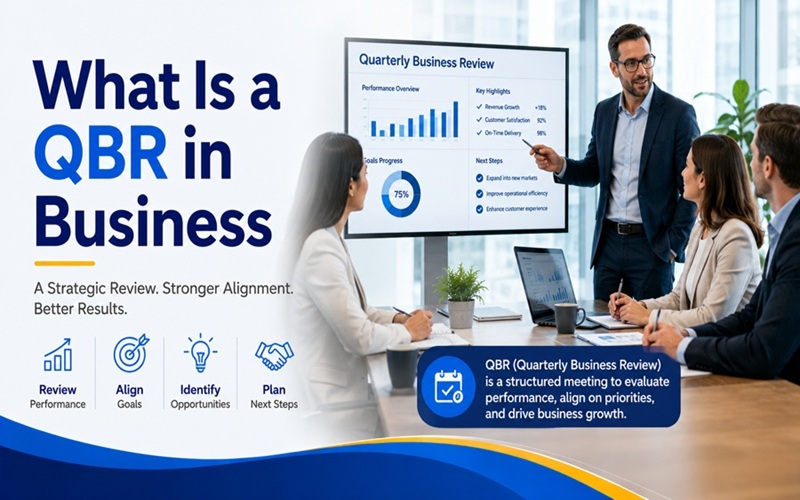
A Quarterly Business Review is a structured meeting held once every three months, either between an organization and its customers, or between leadership and internal teams, to evaluate performance over the prior quarter, identify what is working and what is not, and align on priorities and decisions for the 90 days ahead.
The word that separates a well-run QBR from every other meeting on the calendar is decisions. A QBR is not a status update. It is not a data presentation. It is not an opportunity to replay a dashboard everyone has already seen. A status update tells you what happened. A QBR diagnoses why it happened and commits to what changes next. That distinction is everything.
Deloitte’s 2025 Global Human Capital Trends report found that 61 percent of managers and 72 percent of workers do not trust their organization’s performance management process. A well-run QBR directly addresses that trust gap by grounding performance conversations in transparent, pre-agreed metrics and tying them to specific, documented action items with named owners and real deadlines. The review becomes credible because it is consistent, honest, and actually leads somewhere.
Internal QBRs vs Customer-Facing QBRs
One of the most important distinctions in understanding what a QBR is comes from recognizing that the term covers two meaningfully different types of meetings, and confusing them produces agendas that serve neither purpose well.
An internal QBR is held between leadership and functional teams within the organization. Its job is to review performance against company objectives, surface what blocked progress in the prior quarter, realign on strategic priorities, and make resource allocation decisions before the next 90 days begin. Common formats for internal QBRs include leadership team reviews where executives assess progress against annual goals, cross-functional reviews where departments share performance and dependencies, and sales and operations reviews where pipeline health, forecast accuracy, and capacity are examined together. When internal QBRs work well, they eliminate the information silos that cause departments to optimize locally while the business underperforms globally.
A customer-facing QBR, sometimes called a Client Business Review or Executive Business Review when senior stakeholders are present, is held between a company and one of its customers or clients. Its purpose is to demonstrate the value the vendor has delivered, review progress toward the customer’s stated business goals, surface any problems or gaps in the relationship, and jointly plan for the coming quarter. In the world of SaaS and subscription businesses in particular, customer-facing QBRs have become a critical tool for retention. Customers who participate in regular, well-structured QBRs are significantly more likely to renew and expand their contracts because the meetings continuously reinforce the value of the relationship rather than leaving customers to make their own quiet assessment at renewal time.
What a Strong QBR Agenda Actually Looks Like
Regardless of whether the QBR is internal or customer-facing, the structure that consistently produces useful outcomes follows a recognizable pattern.
The opening should establish context quickly. A brief overview of the meeting purpose, the metrics that were agreed as the performance benchmark at the start of the quarter, and a summary of what was promised at the last QBR and whether it was delivered. Opening with accountability for prior commitments is one of the most consistently underpracticed elements of QBR facilitation, and it is one of the most important. It signals that the meeting is serious and that agreements made here carry real weight.
The bulk of the meeting should be devoted to performance analysis. Not a slide for every number that moved, but a focused examination of the metrics that matter most to the goals that were established. As Salesforce explains in its guide to running effective QBRs, QBRs yield business value on both sides when both parties review shared successes together and use that foundation to identify improvement opportunities and reaffirm overarching goals. The analysis should surface what worked and why, what did not work and why, and what patterns are emerging that were not visible at the individual monthly level.
Strategic planning for the next quarter follows from that analysis. This is where decisions get made. New priorities are set, resource needs are identified, and next quarter’s commitments are agreed upon with specific owners and timelines attached. A QBR that ends without documented decisions and assigned owners has not produced a plan. It has produced a conversation.
The meeting should close with a clear recap of every commitment made, who owns each one, and when the next touchpoint will occur. A written follow-up distributed within 24 hours that captures decisions and action items is not optional. It is the mechanism that converts the meeting into accountability.
The QBR and OKR Connection
In organizations that use Objectives and Key Results as their goal-setting framework, the QBR serves as the formal review mechanism that gives OKRs their teeth. OKRs set the destination and define what success looks like. The QBR is the quarterly moment where the organization honestly assesses how close it came, what prevented greater progress, and what adjustments are needed going forward.
Teams that run weekly OKR check-ins throughout the quarter find that their QBRs transform from last-minute data scrambles into genuine strategic conversations. Because the Key Results have been tracked consistently, everyone arrives at the QBR with shared context. The meeting can spend its time on analysis and forward planning rather than on establishing basic facts about what happened. This combination of OKRs for ongoing tracking and QBRs for quarterly synthesis is one of the most effective operating rhythms in business today.
The Most Common QBR Mistakes and Why They Happen
Understanding what makes QBRs fail is as valuable as understanding what makes them work, because the failure modes are remarkably consistent across organizations of all sizes.
The most common mistake is treating the QBR as a data presentation rather than a decision forum. When the meeting is structured around reviewing every metric in the dashboard, attendees disengage because they are being told things they already know without being asked to do anything useful with the information. A research finding from senior executives found that 72 percent consider QBRs a waste of time when structured this way. The fix is to anchor the meeting around a small set of metrics that genuinely reflect progress toward strategic goals and to structure the entire agenda around the decisions those metrics require.
The second most common mistake is insufficient preparation. Customer-facing QBRs in particular require research into how the customer has used the product or service, what outcomes they have achieved relative to their stated goals, and what is coming up in their business that should shape your joint planning. Showing up with generic slides built from internal data without tailoring the content to the specific customer’s context signals that the meeting is more about the vendor than the client.
A third common failure pattern is the wrong attendees. The value of a QBR increases meaningfully when decision-making stakeholders are present on both sides. A meeting attended only by operational contacts on the customer side, without the economic buyer or executive sponsor who can authorize commitments, limits what can realistically be agreed upon. Getting the right people in the room, or on the video call, is an investment worth making.
Finally, failing to follow through on prior commitments undermines every subsequent QBR. If the previous meeting produced action items that were never completed, the opening of the next meeting becomes uncomfortable at best and trust-destroying at worst. Organizations that treat QBR commitments with the same seriousness as contractual obligations build a cadence of accountability that makes the entire review process more valuable over time.
Why the QBR Cadence Matters Beyond Any Individual Meeting
One of the most underappreciated aspects of the QBR as a business practice is what happens when it becomes a reliable, consistent cadence rather than an occasional event. Quarter over quarter patterns that are invisible in daily reporting become clearly visible when data is reviewed at consistent intervals with structured analysis. Revenue trends, customer health shifts, operational bottlenecks, and team performance trajectories all become more interpretable when viewed through the structured lens of quarterly comparison.
The discipline that a regular QBR cycle imposes on an organization is genuinely valuable independent of any individual meeting’s content. It forces a rhythm of reflection and planning that many businesses desperately need. It creates accountability structures that outlast any single conversation. And it builds the organizational habit of measuring what matters, reviewing it honestly, and making decisions based on what the evidence shows rather than on assumption or inertia.
Done well, the QBR is not a meeting. It is a management system that makes every quarter more intentional than the one before.
