

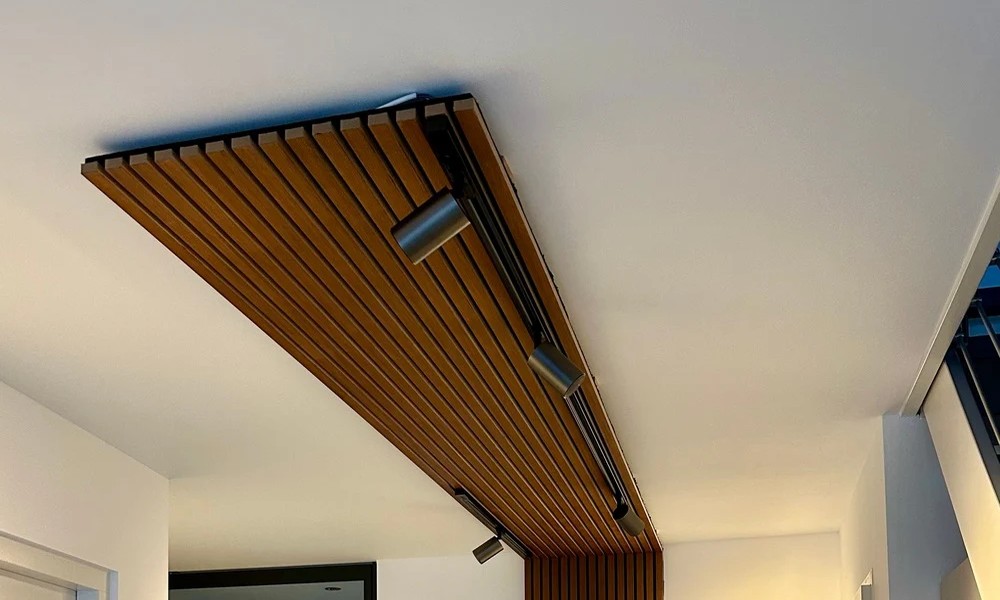
Most people approach acoustics the same way, they look up. Ceilings feel like the obvious place to start. They’re wide, unobstructed, and seem like the perfect surface to “catch” sound.
But once you spend time in real spaces, offices, meeting rooms, even homes, you start to notice something else.
A lot of the problems you’re hearing? They’re not coming from above.
They’re happening right in front of you, around you, and across the room.
That’s usually where acoustic panels for walls step in and do a better job than ceiling-only solutions.
Sound doesn’t behave the way people expect.
It’s easy to imagine sound rising upward and bouncing back down.
But in reality, most everyday sound moves sideways.
Think about a normal conversation. It travels:
- From one person to another
- Across tables
- Between parallel walls
So when a room feels echoey or messy, it’s often because sound is bouncing back and forth, not just up and down.
That’s why wall mounted acoustic panels tend to feel more effective in certain spaces-they’re placed directly in the path where sound is actually travelling.
When the problem feels “in your face,” not above you.
Here’s a simple way to think about it.
If you’re sitting in a room and:
- Voices feel like they’re bouncing around you
- You hear reflections almost immediately after someone speaks
- The space feels “tight” or slightly chaotic
That’s usually a wall reflection issue.
Ceiling panels can help soften the overall sound, but they don’t always catch those fast, direct reflections happening at ear level.
Wall panels, on the other hand, deal with the problem right where you experience it.
High ceilings can work against ceiling solutions.
In rooms with higher ceilings, there’s more distance between the sound source and the ceiling itself.
That changes things.
By the time sound reaches the ceiling:
- It’s already lost some energy
- It has already bounced off walls multiple times
- The reflections people notice have already happened
So even if ceiling treatment is installed, it might not address the reflections that are actually bothering people.
That’s where acoustic wall panels come in earlier in the sound path, which makes their impact feel more immediate.
Sometimes it’s just about practicality.
Not every space allows for ceiling work.
You might have:
- Exposed pipes or ducting
- Lighting systems that can’t be moved
- Limited access due to height
- Design constraints that don’t allow modifications
In these cases, even if ceiling treatment is ideal on paper, it’s not always realistic.
Wall panels are simply easier to work with.
They can be installed without disrupting other systems, adjusted over time, and even repositioned if needed.
When sound keeps bouncing between two sides.
There’s a specific kind of echo that’s very common but not always obvious.
It happens when sound gets trapped between two parallel surfaces-like two walls facing each other.
You’ll notice it as:
- A slight flutter or rapid echo
- A “ping-pong” effect when someone speaks
- Certain spots in the room sounding worse than others
Ceiling panels won’t fully fix this, because the reflection path is horizontal.
Wall panels break that cycle directly, which is why they tend to perform better in this kind of setup.
Open spaces need more than overhead control.
In open-plan environments, the issue isn’t just echo-it’s spread.
Sound doesn’t stay where it’s created. It travels.
You might hear:
- Conversations from across the room
- Noise drifting from one zone to another
- A constant layer of background activity
Ceiling solutions help reduce overall reverberation, but they don’t always stop sound from moving sideways.
Wall panels help contain that movement.
They act like checkpoints along the way, reducing how far sound can travel and keeping things more localised.
When you need to fix a specific problem, not the whole room.Ceiling treatments are great for general improvements. But what if the issue is more specific?
Maybe:
- One wall is causing strong reflections
- A meeting area feels louder than the rest
- A particular zone is harder to work in
In these cases, going overhead might be too broad.
Wall panels give you more control. You can target the exact problem area instead of treating the entire space.
That makes adjustments more efficient, and often more effective.
Design flexibility plays a role too.
There’s also a design angle that’s hard to ignore.
Ceiling panels are usually subtle, sometimes even hidden.
Wall panels, on the other hand, can:
- Blend into the design
- Add texture or visual interest
- Be customised to fit the space
So instead of feeling like an add-on, they can become part of the interior itself.
That makes them easier to justify, especially in spaces where appearance matters just as much as function.
Final Thoughts
Ceiling solutions aren’t wrong-they’re just not always the most relevant first move.
In many real-world situations, the issues people notice are happening at ear level, across the room, and between surfaces, not above their heads.
That’s why acoustic wall panels often feel more effective:
- They meet sound where it travels
- They address reflections people actually hear
- They offer more targeted and flexible control
Once you start looking at acoustics this way, the approach shifts.
