

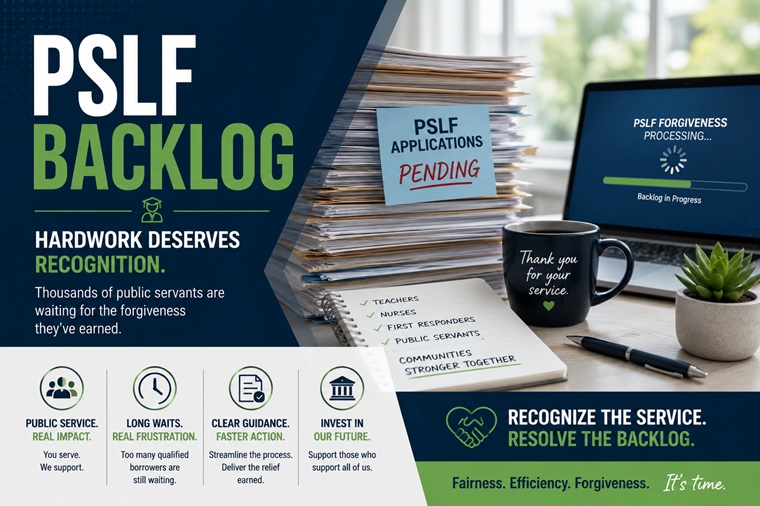
As of early 2026, the Public Service Loan Forgiveness (PSLF) program has a significant backlog of pending applications — specifically, 88,170 PSLF Buyback applications were pending as of February 28, 2026, according to Department of Education filings. The broader student loan landscape has additional backlogs: roughly 576,000 income-driven repayment (IDR) applications were also pending in late February, down from over 730,000 at the end of 2025. Borrowers have reported wait times of 14+ months for PSLF buyback decisions.
The backlog exists because of a combination of factors: a surge in applications following Biden-era reforms, the wind-down of the SAVE repayment plan (officially blocked by a federal appeals court in March 2026), administrative changes under the current administration, and the operational complexity of processing PSLF buyback applications individually. Processing continues, but the pace isn’t keeping up with new application volume, so the buyback backlog has been growing modestly.
The Backlog by the Numbers
| Application Type | Pending (as of Feb 28, 2026) | Trend |
|---|---|---|
| PSLF Buyback applications | 88,170 | Growing slowly |
| IDR applications | 576,609 | Falling (down from 734K in Dec 2025) |
| PSLF forgiveness applications (general) | Tens of thousands | Variable |
PSLF Buyback specifically — the option that allows borrowers to retroactively pay for months missed due to forbearance or deferment — is the slowest-moving category. The Department has been receiving roughly 4,000+ new buyback applications per month while deciding on about 2,500, meaning the backlog continues to grow.
What Caused the Backlog
Surge in eligibility. Biden-era reforms expanded PSLF eligibility retroactively, letting hundreds of thousands of borrowers count payments that previously didn’t qualify. Application volume outpaced processing capacity.
SAVE plan complications. The SAVE repayment plan, enacted in 2023, was contested in federal courts and officially blocked by an appeals court in March 2026. The 7.5 million borrowers enrolled were directed to choose new plans within 90 days, generating a wave of new IDR applications.
Administrative transition. The shift between administrations introduced policy changes that affected processing.
Buyback complexity. Each buyback application requires individual review of employment history, payment records, and forbearance periods. The work doesn’t lend itself easily to automation.
What’s Changing for Borrowers
End of SAVE. Borrowers in SAVE need to enroll in a new repayment plan. The options remaining: Income-Based Repayment (IBR), Income-Contingent Repayment (ICR), Pay As You Earn (PAYE) — though some of these are also being phased out — and the new Repayment Assistance Plan (RAP), set to become available in summer 2026.
RAP plan launch. Under the One Big Beautiful Bill Act, new borrowers will only have access to RAP as their income-driven option. RAP has a minimum $10 monthly payment, includes a principal subsidy for PSLF borrowers, and treats unpaid interest more generously than older plans.
Consolidation deadline. Borrowers who want to keep access to legacy IDR plans need to consolidate their loans before July 1, 2026. Missing the deadline locks them into RAP.
Higher buyback costs. Under recent policy changes, PSLF buyback costs are now calculated using the IBR formula rather than the (now-blocked) SAVE formula — making buyback more expensive for many borrowers.
What Borrowers in the Backlog Can Do
Keep working in qualifying employment. Every month of qualifying public service employment counts toward the 120-month total. Don’t leave a qualifying job because of processing delays.
Submit the PSLF Employment Certification Form annually. Annual certification creates the documentation trail regardless of when forgiveness is processed.
Apply for buyback if eligible, but don’t expect fast resolution. Despite backlogs, applying is still better than not applying — your application gets in the queue and the credit applies retroactively when processed.
Monitor your account. Watch FSA.gov and your servicer’s portal for status updates. Be ready to respond quickly to document requests.
Consider consolidation before July 1, 2026 if you want to keep access to legacy IDR plans rather than be defaulted into RAP.
What Borrowers Shouldn’t Do
Don’t stop making payments while waiting. Unless you’re explicitly on paused or forbearance status, missing payments creates additional problems without speeding processing.
Don’t pay third-party “forgiveness services.” PSLF applications are free through the Department of Education. Any company charging to apply on your behalf is offering a service you can do yourself for free.
Don’t switch plans hastily. With ongoing legal and administrative changes, making a quick plan change based on one news cycle can lock you into worse terms.
The Bigger Picture
Since PSLF began discharging meaningful numbers of loans in 2022, over 1.2 million borrowers have received roughly $90.6 billion in forgiveness through January 2026 — averaging about $75,000 per borrower. So the program is working at scale. The backlog reflects the program’s growth, not failure, though the wait is real and painful for borrowers waiting on their own forgiveness.
Bottom Line
The PSLF backlog in 2026 is real and growing for buyback applications, but processing continues and forgiveness still happens. Borrowers in qualifying employment should keep applying, certify employment annually, and watch the deadlines around the SAVE wind-down and RAP rollout. The system is slow and changing, but the underlying program is intact. Patience and documentation are your best tools while waiting.
