

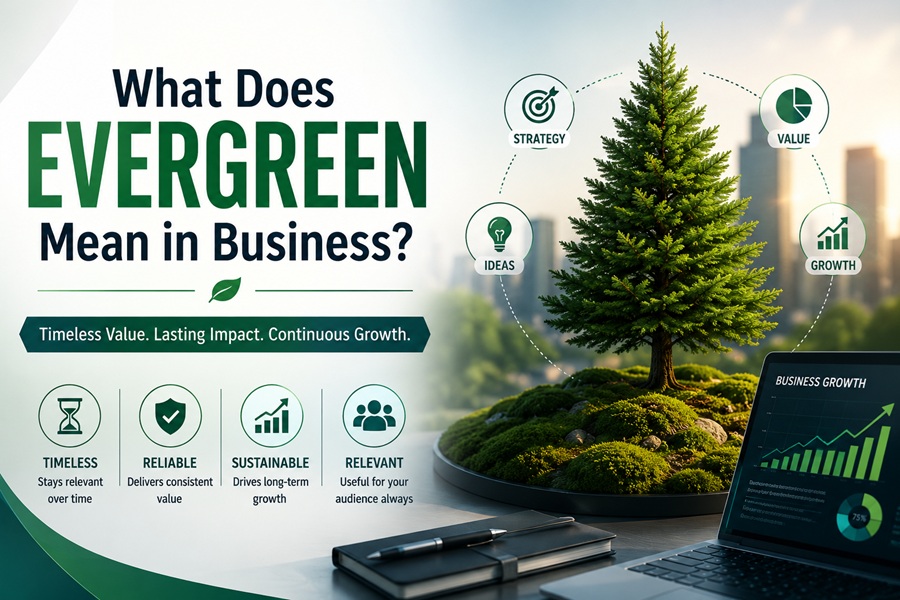
Borrow a term from forestry, apply it to commerce, and you get one of the more useful concepts in business strategy. Evergreen, in a literal sense, refers to trees that retain their leaves year-round — they don’t shed, they don’t go dormant, they keep going regardless of season. In business, the meaning tracks closely: something evergreen stays relevant, functional, and valuable over time without needing constant reinvention.
It sounds simple. In practice, building something truly evergreen is harder than most businesses expect.
The Core Meaning in a Business Context
When a business professional calls something evergreen, they typically mean one of three things — a product, a piece of content, or a revenue model — that doesn’t have a built-in expiration date.
A trend-driven product tied to a specific cultural moment isn’t evergreen. A fidget spinner isn’t evergreen. A quality kitchen knife that solves the same problem it solved fifty years ago is. The distinction isn’t about being boring or uncreative — it’s about whether the underlying value proposition depends on circumstances that can change.
The term gets used across several different business functions, each with a slightly different emphasis.
Evergreen in Content and Marketing
This is where the term shows up most often in day-to-day business conversation. Evergreen content is material — articles, videos, guides, tutorials — that remains useful and searchable long after it’s published. It doesn’t report on breaking news or seasonal trends. It answers questions people will keep asking regardless of what year it is.
A guide explaining how compound interest works is evergreen. A recap of last quarter’s market movements is not. For businesses investing in content marketing, the distinction matters enormously for return on investment. A well-written evergreen article can drive consistent organic traffic for years. A news-driven piece might spike and disappear within days.
The practical implication: evergreen content requires more upfront investment in research and quality, but the long-term return typically outpaces trend-chasing content by a significant margin.
Evergreen Products and Business Models
Beyond content, the concept applies directly to what a business sells. Evergreen products address needs that don’t go away — staple goods, professional services, infrastructure, maintenance, and repair all tend to fall into this category.
Subscription-based businesses are sometimes described as evergreen models because, when built correctly, they generate recurring revenue without requiring constant acquisition of new customers. The retention mechanics built into a good subscription product mean that revenue compounds rather than resets with each sales cycle.
Private equity and investment circles also use “evergreen” in a specific technical sense: an evergreen fund is a vehicle that reinvests returns rather than distributing them at the end of a fixed term. Unlike traditional closed-end funds that wind down after seven to ten years, evergreen funds maintain a rolling investment horizon — which changes both the strategy and the investor relationship considerably.
Why Businesses Deliberately Build for Evergreen
The business case for evergreen thinking comes down to efficiency. Constantly chasing what’s new — new trends, new platforms, new product lines — is expensive. It demands continuous marketing spend, product development cycles, and audience re-education. Companies that build evergreen foundations can allocate resources more predictably because their core offering doesn’t require perpetual reinvention.
That doesn’t mean ignoring change. The strongest businesses combine an evergreen core with deliberate, selective adaptation. Their fundamental value proposition stays stable; the way they deliver and communicate it evolves with the market.
According to the Harvard Business Review, companies with durable competitive advantages — what some strategists call “moats” — tend to be built around products or services that solve persistent problems rather than riding temporary demand curves. Evergreen strategy, in essence, is long-game thinking applied systematically.
The Limits of Evergreen Thinking
Evergreen isn’t a universal virtue. Some industries move fast enough that clinging to a stable model becomes its own risk. A business that defined itself as evergreen in physical retail, physical media, or print publishing over the past two decades found that “timeless” can become “obsolete” faster than expected when the underlying delivery mechanism shifts fundamentally.
The honest version of evergreen strategy acknowledges this: you’re not building something immune to change, you’re building something whose core value travels well across change. That’s a different — and more defensible — proposition.
FAQ: Evergreen in Business
What is the simplest definition of evergreen in business? Something evergreen remains relevant and valuable over time without requiring constant updates or reinvention. It solves a problem that doesn’t go away.
What is an example of evergreen content? A beginner’s guide to budgeting, an explanation of how SEO works, or a tutorial on reading a balance sheet — these answer questions people will keep searching for regardless of the year.
What is an evergreen fund? An evergreen fund is an investment vehicle that reinvests its returns on a continuous basis rather than distributing capital at the end of a fixed term. It has no defined wind-down date.
Is an evergreen business model better than a trend-driven one? Not universally. Evergreen models offer stability and compounding returns over time. Trend-driven models can generate faster, larger short-term gains. Most durable businesses combine both — a stable evergreen core with selective trend-responsive offerings layered on top.
How do you make content evergreen? Focus on questions with long-term relevance, avoid references to specific dates or current events, write with enough depth to be genuinely useful, and update the piece periodically to keep facts and examples current.
Why do marketers prioritize evergreen content? Because it continues to generate organic traffic and leads long after publication without additional spend. The cost-per-lead on a well-ranked evergreen article typically drops significantly over its lifespan.
